Part 1 of 6 · The one-person finance team
How do you model runway and burn without financial statements?
No financials, no ledger. But leadership needs to plan and investors are asking. What do you do?
In this part
- With no ledger or past financials, the only source of truth was the transactions. Claude transcribed 4.5 months of statements, and a second agent checked every month's closing balance.
- Briefed like a junior analyst instead of left to build a lookup formula, Claude classified more than 1,500 transactions in a day.
- Runway needs cash, not revenue. Gross burn gave leadership a conservative answer in 13 days, while revenue waited for a bigger fix.
Hi, I'm Mathew. This spring, a Singapore startup asked me to clean up its finances and build the systems it would need to scale after its Series A.
Why me? I'm neither an accountant nor a tax advisor. I'm an operator: a former bank strategy consultant who has raised a Series A and quarterbacked an exit.
This series is what I fixed, the decisions I made, and how I did it in six months with just Claude and an external accountant. I'm sharing it in the hope that it's useful, and that you'll share what worked for you.
"Can you send me the ledgers/books?"
Five days before my first day, I asked the question on an onboarding call.
"We don't have one," came the answer. No general ledger. Prior years were kept on a cash basis by a corporate secretary. No contract or invoice schedules, no AP or AR. And nobody had kept the books that year: the previous corporate secretary had moved on a few months earlier, without handing over any financials.
The Series A had closed four months earlier, and the founders had doubled down on growing the business. Finance and reporting was an afterthought, until the investors started asking for it.
Now, as an operator, it was the healthiest sign of a company focused on the right thing: growth. But it also meant my job just got much bigger.
Leadership and investors needed two answers to make hiring and prioritization decisions: how much do we spend each month, and how long does that give us to hit the milestones for the next raise? Pricing, cost controls and reporting systems could wait. This post is how I built those answers in 13 days, without financials or a general ledger.
1. Scope it as narrowly as possible
2026 only. Without reliable FY25 financials or a ledger, the model had to be cash basis, which is fine for runway and burn. It answers three questions: what we burn each month, how long the cash lasts, and the envelope for the Q3 budget. Nothing else.
2. Decide what data you can trust
Without a general ledger or reliable past financials, the only source of truth left is the company's transactions.
So step 2 was practical: secure statements from every account the company transacted through. Here, that meant the main bank (OCBC), Wise (cross-border payments) and Stripe (invoicing).
3. Create source of truth #1: A complete list of transactions
Claude's first job was mechanical: Take 4.5 months of statements and transcribe them into a spreadsheet with the following requirements:
- One row per transaction,
- one tab per source account, and
- a column computing the running statement balance.
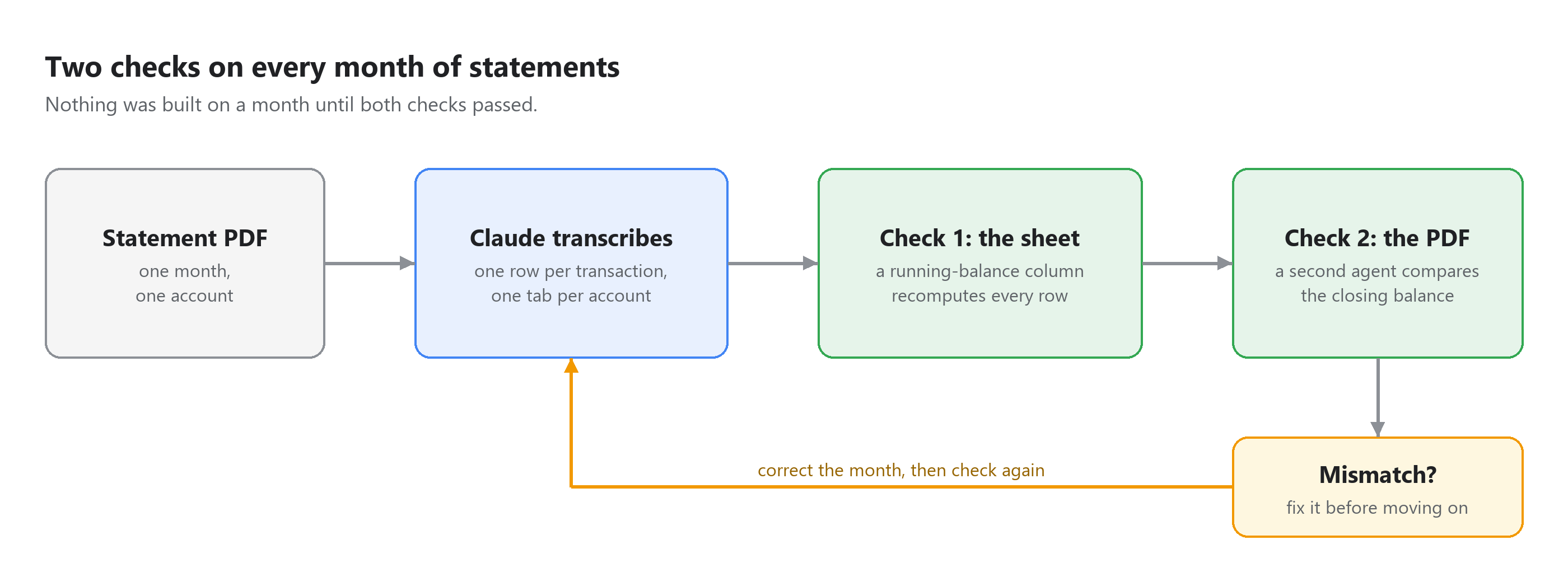
A second agent ran a simple control after each month was transcribed:
Check the last row for a given month in the transcribed spreadsheet. Does the statement balance match the closing balance from the source PDF?
Using a second agent meant the extraction agent never graded its own work. A month whose balances didn't match was fixed before anything was built on it.
By May, there were already over 2,000 transactions, and Claude transcribed them in an afternoon. Acquiring the statements, i.e. my job, had become the bottleneck.
4. Before modeling, develop an intuitive sense of the business
I ran two analyses in parallel. In one, I built pivots by month, by who initiated each payment, and by payee. In the other, I gave Claude the data and asked it to summarize the same cuts.
Two things stood out straight away:
- Concentration: three people initiated 95% of payments by value, and 80% of spend went to 15% of the nearly 300 payees, mostly payroll, contractors, legal and rent.
- Acceleration: from January to April, the number of payments grew by more than 60% while spend grew more slowly, implying a growing long tail of small transactions.
I now knew who to get context from, and where to focus effort on modeling accuracy. But the growing tail opened a new question: how is spend changing? Within weeks, I had been looped into no fewer than 30 "budget approval" requests. But this was a problem for later.
Having personally reviewed the most material 80% of spend, classifying the remaining 20% (made up of hundreds of low-value payments) seemed like a great test for AI.
5. AI for the long tail of low-value transactions
I set Claude and Gemini on the task at the same time, on separate files. Claude did better, and its descriptions became the ones I worked from.
The prompt was simple:
Use the merchant name and description in columns E and G, find the most likely description through a web search, and add it to column P (column R for Gemini).
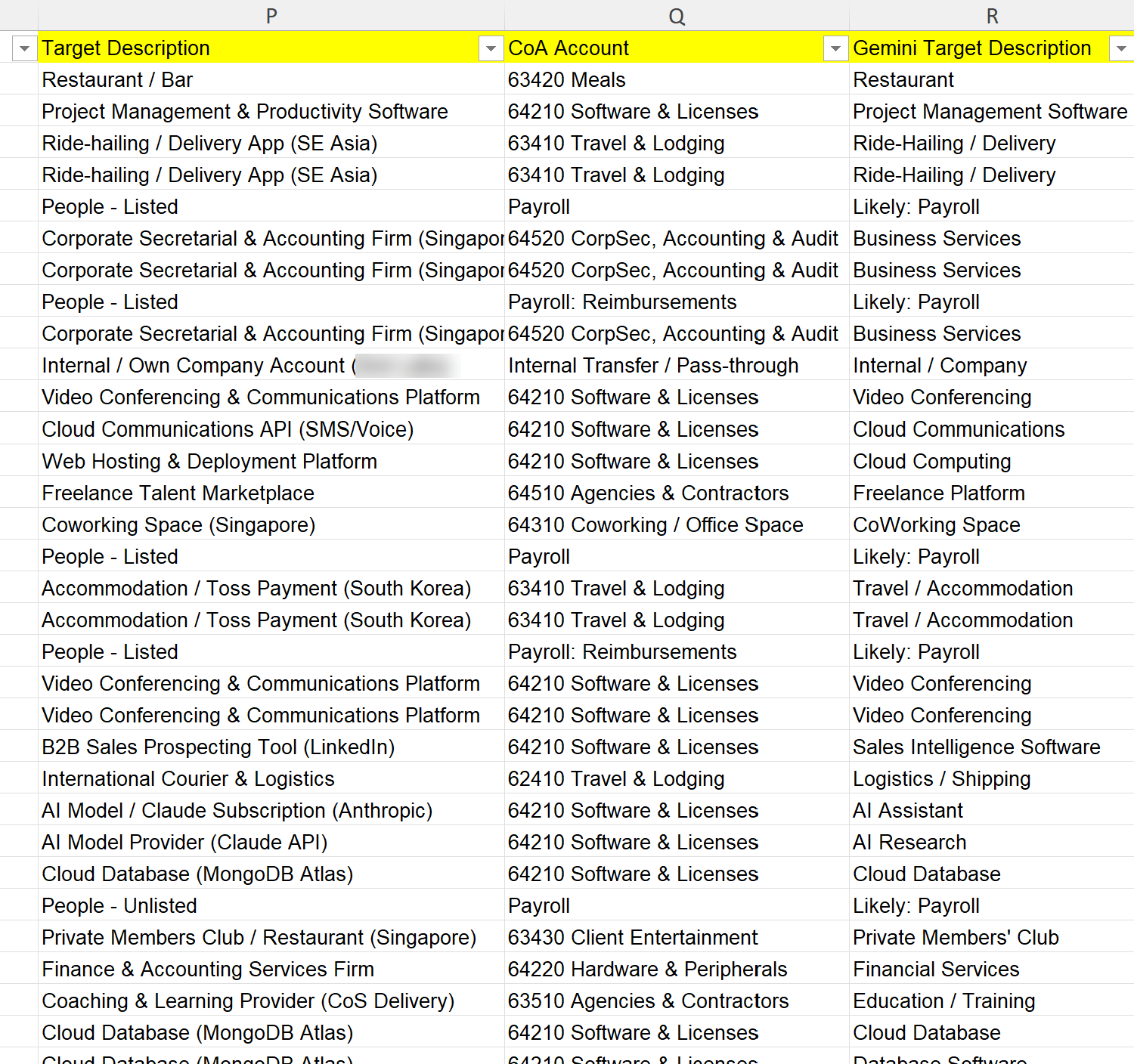
A pivot gave me a unique list of descriptions, which I used to shape a first version of the chart of accounts (pictured below).
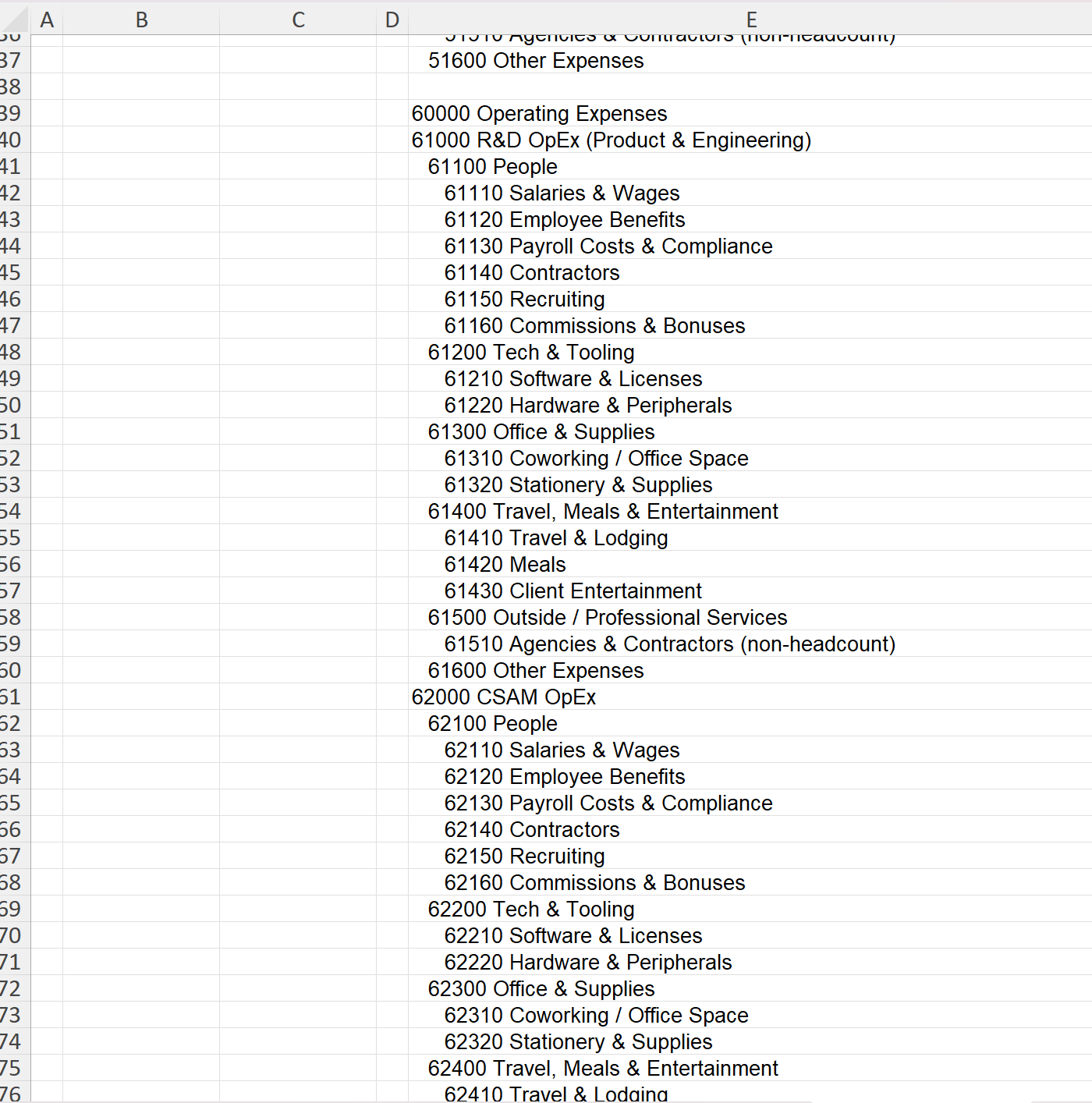
Then I had Claude match each transaction to an account. At first, it built a lookup formula. I stopped it and used a different strength instead: visual review.
The prompt:
Context: Review the attached chart of accounts and note its structure by team. Allocate the following payees to teams as follows: [list]. Here are a few exceptions: [list].
Task: Visually inspect each transaction, including the payee, merchant and target descriptions. Apply your best-guess account from the attached chart of accounts, observing the allocations and exceptions above.
Process: 1) Apply an initial mapping and a confidence level. 2) Show me the highest-confidence batch for approval in chat, and process my feedback. 3) Show me the next batch the same way. 4) Continue until every row is mapped.
The lookup had taken 15 minutes and produced too many mistakes. So I instructed Claude the way I'd brief a junior analyst: here are the guardrails, apply them, iterate with me, apply again.
We classified more than 1,500 transactions in a day.
Where Claude was wrong: in the first pass, an accounting firm was coded to Hardware & Peripherals. The description was right; the account wasn't. The lookup couldn't see the mismatch. In the visual review, a description that didn't fit its account stood out, and the batch-by-batch approval caught it before it reached the model.
6. Structure the model: output > sources > engines
I built the model in three passes, starting from the end:
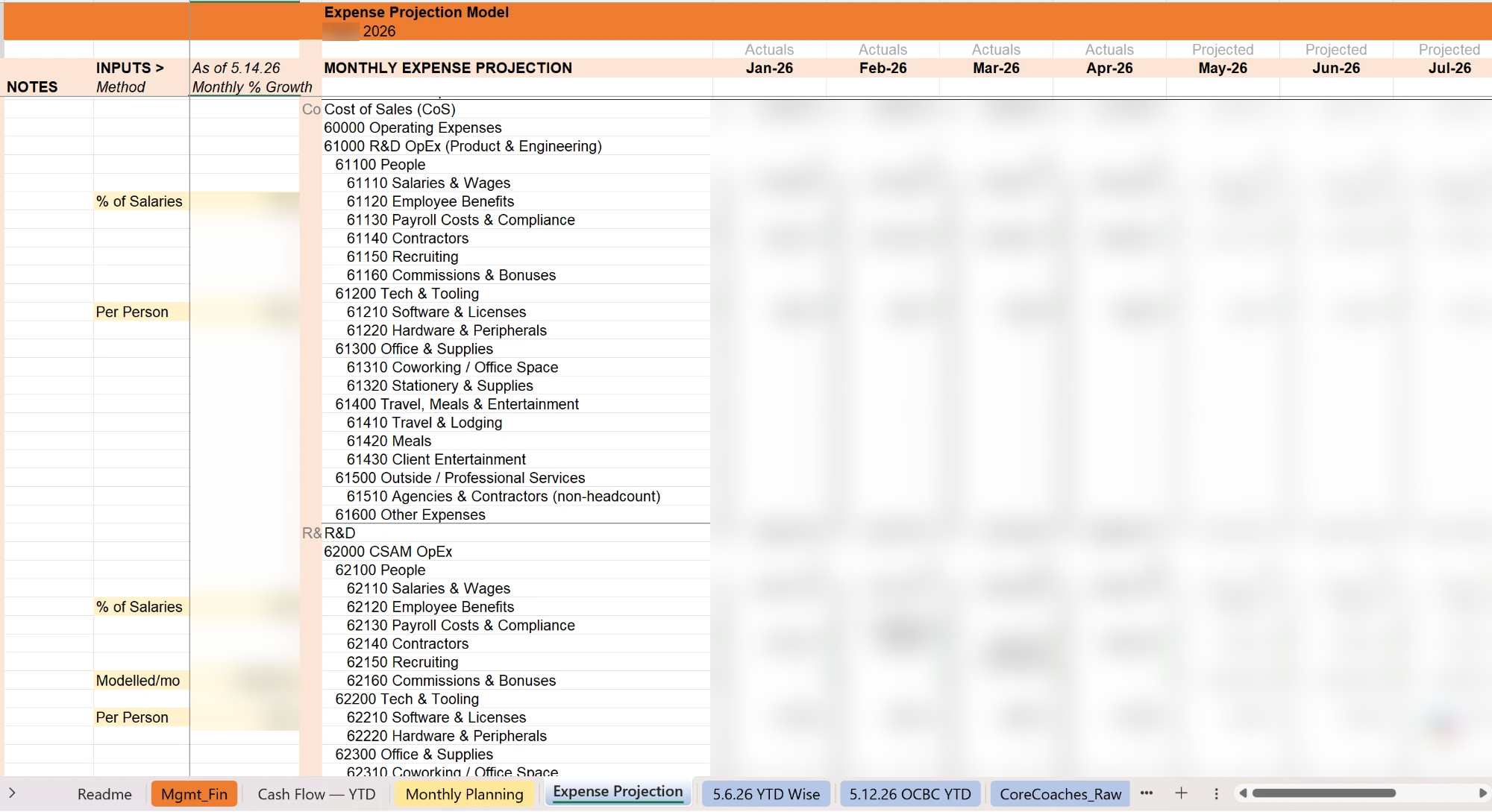
- Map the output. A monthly and quarterly management summary: a P&L view down to burn and closing cash.
- Map a source of truth to every line of that output. Consolidate our sources: transactions (source of truth #1), the payroll roster and hiring plan (source of truth #2), and a placeholder for revenue (more on this below).
- Build the engines that turn raw inputs into outputs. Expenses by account, with an actual or projected switch on every month. Payroll person by person, with start dates and loaded cost. Variable costs: usage costs as a percentage of live revenue, commissions driven by collection, etc.
Claude worked like an analyst. I set out the structure and coded the first few lines myself; once it had a template it could copy, I asked it to fill in the rest.
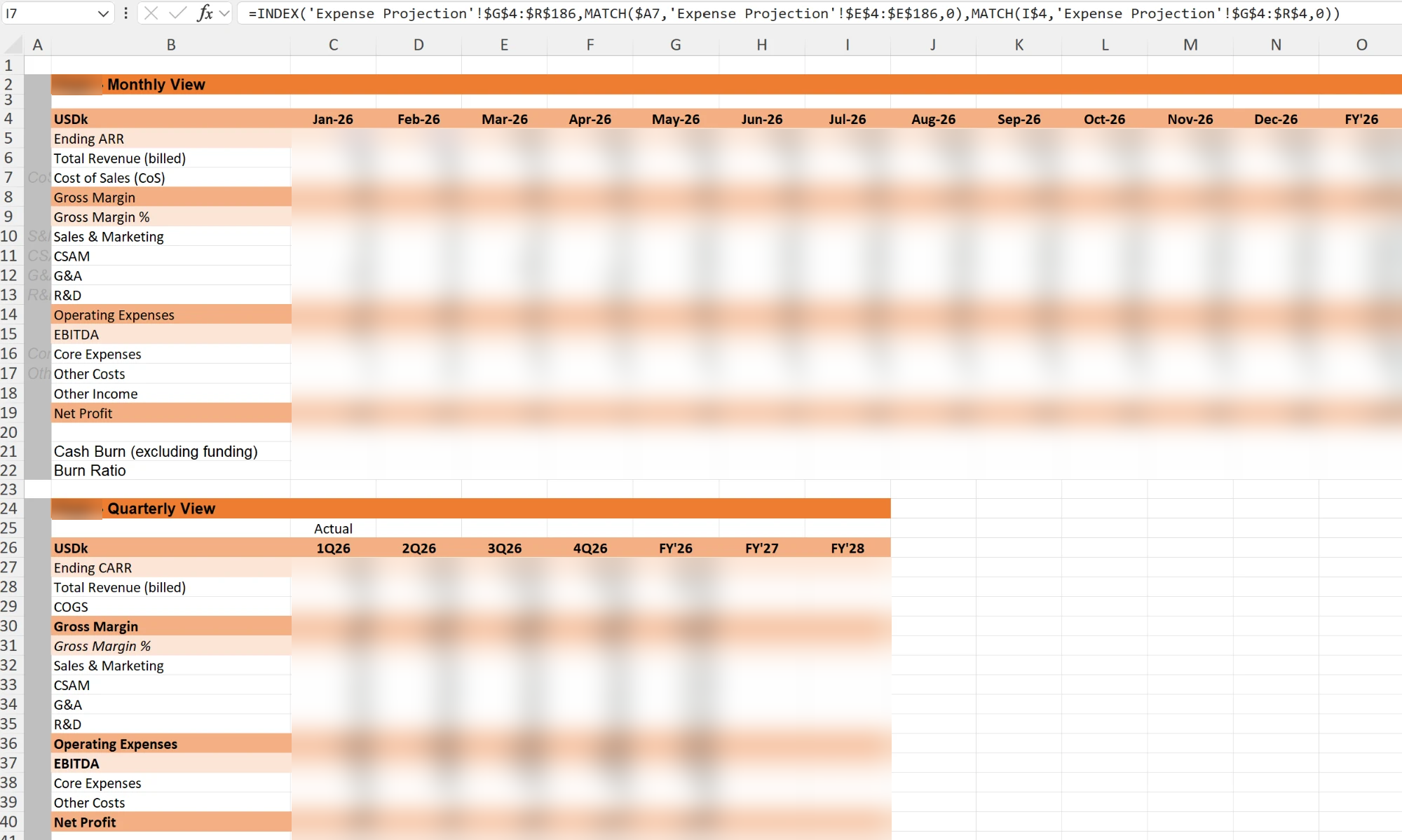
Three definitions held the output together:
- Gross burn: total cash out in a month.
- Net burn: cash out minus cash collected.
- Runway: cash on hand divided by monthly burn.
For runway, I used gross burn, the conservative choice: it didn't depend on revenue being right, and every dollar collected only extended it. Net burn followed once there was a collection schedule (step 7).
7. Revenue: a whole other problem
There was no system of record for customer contracts ("booked"), MRR ("live"), invoices ("billed"), or matched receipts ("collected"). For a software company four years into selling, revenue had become the most complicated part of its financial picture.
There were four partial views, each kept for a different job:
- The CEO's contracted-revenue tracker, the commercial view used to run sales.
- An invoice register, kept by a junior teammate alongside their main role.
- Stripe, which held 80% of invoices; receipts had never been matched, and only 25% of invoices marked "paid" had a card payment behind them.
- Bank receipts, showing what was collected, but not the invoice it settled.
I was under two pressures at once: a burn number for runway, and a revenue figure that aligned to the CEO's tracker. But reconciling four incomplete views was not possible in the time we had.
So I split the question.
Runway doesn't need revenue to be right; it needs cash. The answer leadership needed fit in one sentence:
"We have N months at today's run rate, and every $X we collect buys another month."
That answered runway and gross burn straight away, and became the foundation of the Q3 budget.
For the presentation, I kept the CEO's contracted revenue as the headline, since it was the number leadership managed by. From it, I derived a billing and collection schedule to project net burn, with every assumption leaning conservative.
Revenue itself, one number that ties to a contract, an invoice and a receipt, would need a much bigger effort, which comes later in the series.
What I'd do differently
I started the work before I’d sized it. Without a general ledger, my first month went into a model that was directional at best, and couldn’t be rolled forward because nothing sat underneath it.
Yes, every shortcut was defensible: leadership got the answers it needed, when it needed them. But the diagnosis came out of the work instead of before it.
By the time I saw the full scope (a ledger to build, eighteen months of history to load, revenue to rebuild from scratch, budgets, treasury, projections, compliance, and more), I had too much on the list and too little bandwidth. And things were about to get harder.
Next time, I’d spend the first two weeks on diagnosis alone, then size the team to the job. Done properly, I’d probably have recommended hiring three of me, each armed with Claude.
Takeaway: You don't need finished accounts to model runway. You do need a general ledger to run a finance function, and getting one right takes far more than bookkeeping.