Part 2 of 6 · The one-person finance team
Why pay for a ledger, and how do you choose the right one?
Excel reports had worked fine so far. What’s under the hood of a ledger, and why I didn’t choose the one I really wanted.
In this part
- A general ledger earns its cost over Excel with three things: linked tables, an audit trail, and automation.
- AI-native ledgers fell at the first filter, Singapore statutory accounts and GST. Xero won on integrations and on the accountants already knowing it.
- Keep your AI's working context as plain files that live outside any one tool.
New to the series? It follows one finance lead rebuilding a startup's finance function with Claude. Start with Part 1.
1. Why do we need accounting software?
It was one of the first questions I was asked, and it was a fair one.
The CEO had received Excel reports right through the end of FY25, and they had done the job. So when I asked for $1,000 a year for Xero's premium plan, I got real pushback.
I have a confession: I couldn't articulate why.
That evening, I asked Claude:
If I open the hood of NetSuite, QuickBooks, or Xero, what will I see? And will it really be different from Excel? After all, you can express a company's entire general ledger as one long spreadsheet.
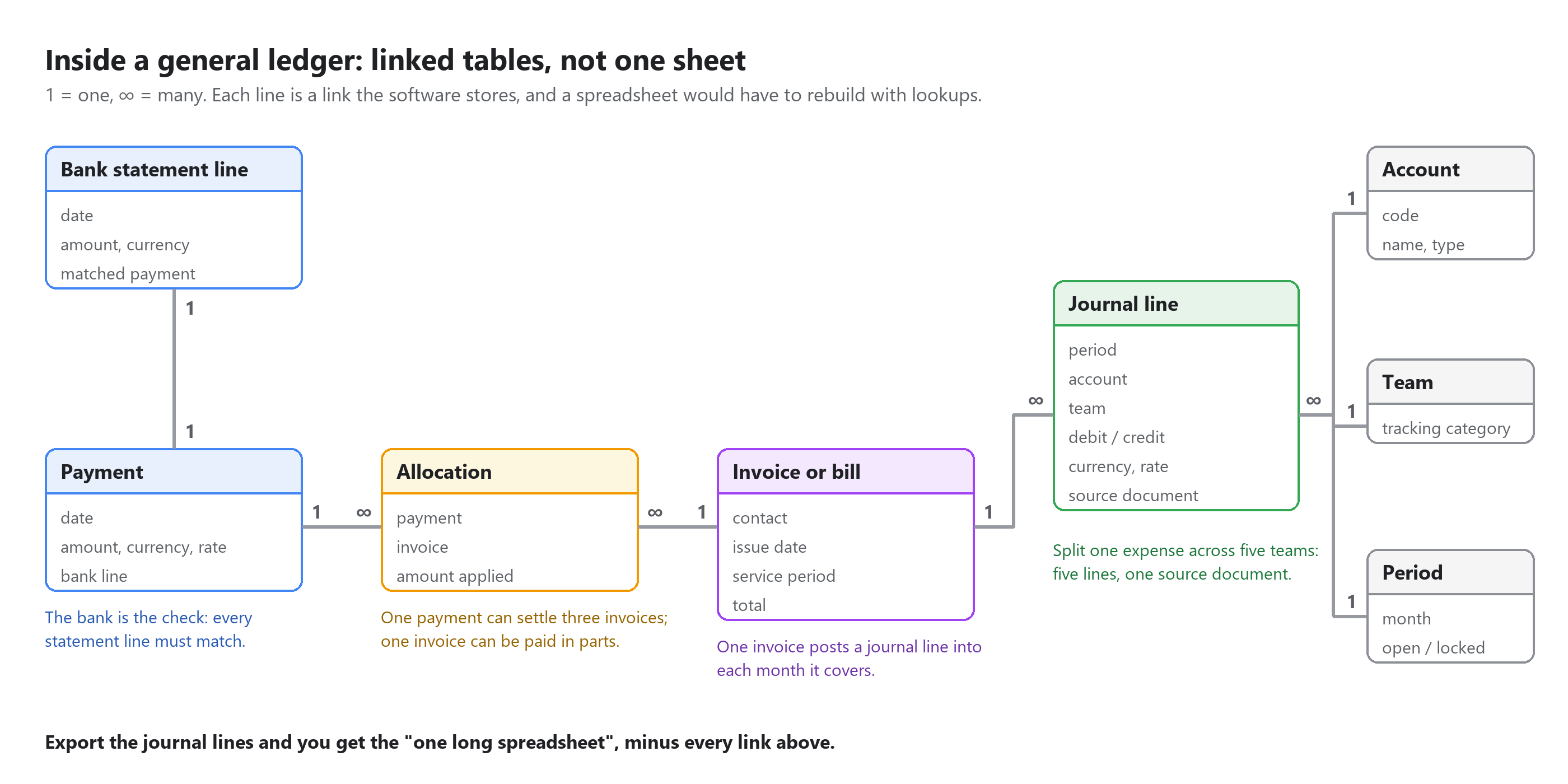
It patiently explained that there were three things that made a general ledger, the core of any accounting software, worth paying for:
- Relational database links. A ledger is many tables linked many-to-many: one payment may settle three invoices, one invoice may be recognized evenly over six months, one expense may split across five teams. The software keeps those links; a spreadsheet rebuilds them with lookup formulas every time it recalculates.
- Audit trail. Every entry and change is recorded, with who made it and when. An auditor spends their time testing the ledger. Without an audit trail, they'd have to rebuild parts of it too.
- Automation and delegation. Bank feeds bring transactions in daily, matched items reconcile in a few clicks, and the statements and GST return come out with little configuration. And a whole team of accountants can work in it at the same time.
With buy-in secured, I began weighing the best option for the company.
2. How I chose the ledger
I went in wanting an AI-native ledger, built around automation from day one. I didn't get one.
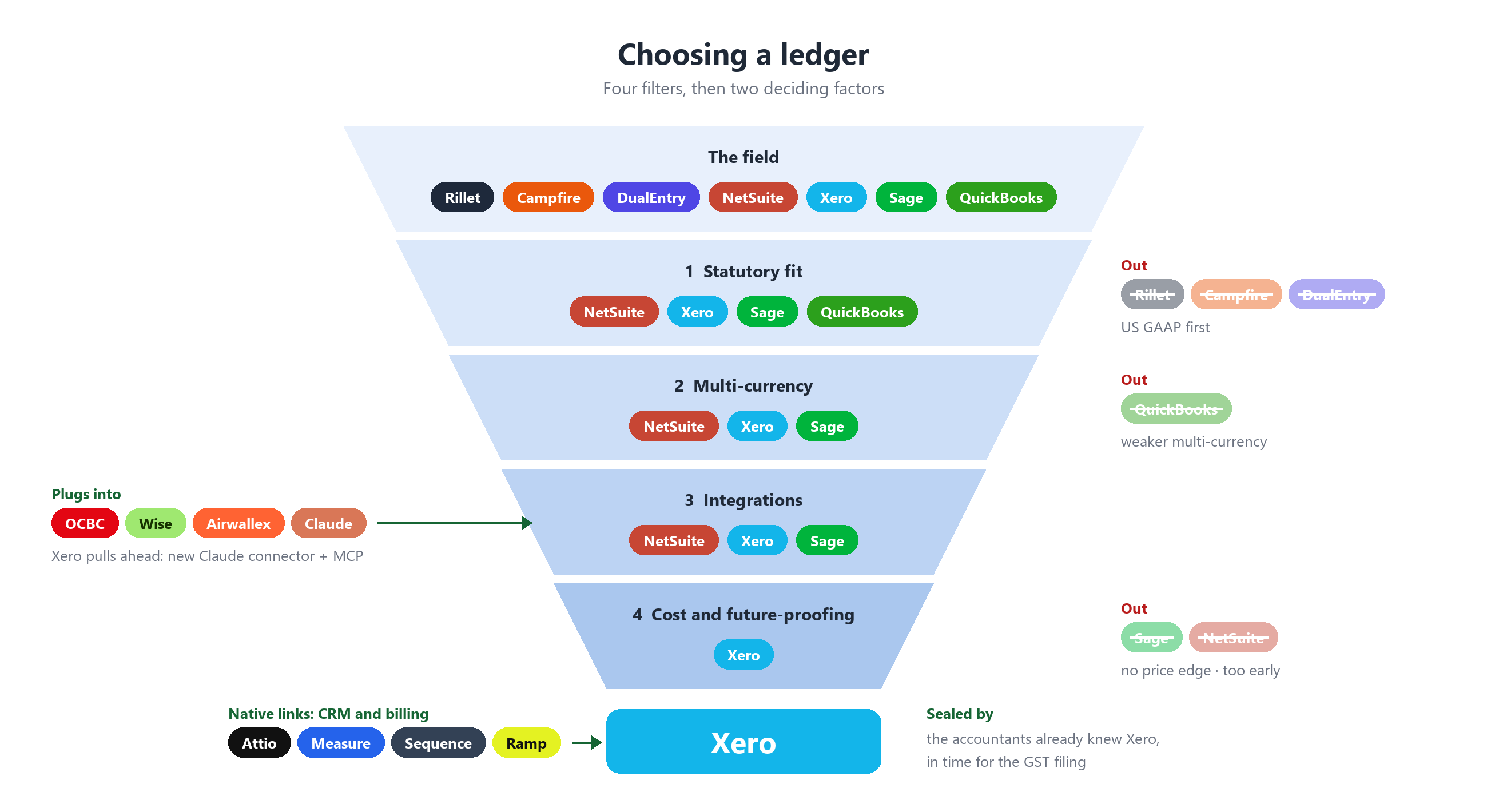
Statutory fit. The first filter was non-negotiable: the company is incorporated in Singapore, so the ledger had to produce Singapore statutory accounts and GST returns.
That took out my personal front-runners: the new AI-native ledgers like Rillet, Campfire, and DualEntry. They were built for US companies and US GAAP first (though this may have changed since).
The shortlist became NetSuite, Xero, Sage, and QuickBooks.
Multi-currency and multi-entity. The company needed a ledger built to handle transactions in at least five currencies, and it was likely to add two or more subsidiaries.
At this juncture, QuickBooks fell out of the running: its multi-currency handling was weaker.
Incidentally, it turned out the previous corporate secretary had used QuickBooks, but only ever sent Excel management reports to leadership.
Integrations. The company banked with OCBC, ran cross-border payments on Wise and Airwallex, and used Claude as its AI copilot of choice.
The bank and transaction data feed integrations were comparable across the remaining contenders.
But Xero had just launched a Claude connector, with an MCP server available for more custom workflow automations.
Cost and future-proofing. Sage didn't offer any compelling price advantage. NetSuite tends to make sense only once a company runs three or more entities with a finance team of at least five. That left Xero.
Two things sealed it:
- The corporate secretary and external accounting teams I was considering already knew Xero. They needed 2026 in the ledger quickly so the quarter's GST return could be filed, and a ledger they knew meant no learning curve at the moment we could least afford one.
- Xero had native integrations with the CRM the sales team had selected, and with the contract-management and billing tools I was evaluating.
3. How Claude helped
I ran the whole decision in Claude Cowork, inside a dedicated project. Before asking anything, I gave the project as much context as I had: my role and mission, how I was thinking about the decision, the current state of affairs, the GST deadline, and the tools already in place.
Then I set out my requirements much like I wrote them above. Claude consolidated them into a spec, then sent a few agents out to scour the documentation for each of the tools in consideration, sometimes suggesting alternatives and new entrants.
The prompt:
Role: I'm the finance lead at a Singapore-incorporated SaaS company. You are my industry and functional expert hired to advise me throughout my role. Build a knowledge repo for yourself. Use the context I share in this project.
Task: Recommend a general ledger.
Requirements, in priority order: 1) Singapore statutory accounts and GST returns. 2) Multi-currency (at least five currencies a month) and room for two or more subsidiaries. 3) Integrations with OCBC, Wise, Airwallex and Claude, plus the CRM and billing tools we're evaluating. 4) Cost now, and as we grow.
Process: Turn these into a spec. Research each candidate against it from the vendor's own documentation, cite your sources, and flag anything you couldn't verify. Suggest alternatives I haven't considered.
Keeping all the work inside the project meant the spec, the research and the shortlist lived in one place. If anyone asked "why Xero?", I could have Claude turn it into a short justification document in minutes.
As a final check, I called a friend, a VP Finance at a Singapore-based Series B company, who confirmed my working assumptions.
What I'd do differently
The decision held up. What I'd change is where I did the work.
Cowork was the right tool for a research question: set up a project, give it context, let it fan out. But that one place turned out to be the problem. The context I'd built, from my role and my thinking to the state of the books, was difficult to take with me.
Within a week, I was working mostly in Claude Code, and I spent a good Saturday rebuilding that context in a repo I could carry from tool to tool.
Next time, I'd write the context down as plain files from day one, in a folder that lives independently of any one tool.
Takeaway: The tool has to fit the company's circumstances. I'd have loved to run an AI-native ledger, but personal interest can't drive the decision for a fast-scaling company.
With Xero chosen, the corporate secretary's team started rebuilding the first quarter of 2026 from scratch; we were already late on the GST filing.
But within days, we hit a wall: the FY25 closing balances didn't make sense.